Tuesday, November 1, 2011

Blog moved!

Hi all,
I've converted my whole site to wordpress, so the blog has a new RSS feed.
http://volvoxaureus.com/?feed=rss2


The second is actually old, but I forgot to publish it for some reason.

Thanks!
Amy

Saturday, October 1, 2011

Shop Class

My grandfather died almost a year ago. It’s been a hard one, good and bad, but I’ve been busy and it’s gone by quickly. It’s been a year since I started this post -- I promised to post some thoughts regarding my grandfather and other connected things, pottery-related and not, that I’ve been thinking about for a really long time.

My Grandpa Fred worked for an aerospace company. He could build anything in his garage (and he did). He taught me how to weld and how to use a metal-lathe. He built a stern-wheeler out of blocks of balsa wood and metal. If he needed a certain tool to do a job, but didn't have quite the right thing, he would build it himself.

I wish I had been older when he was younger, or that I had been more interested in hanging out with him in the garage. But I'm grateful for the things my grandfather gave me -- good spacial-visualization, confidence in my ability to make things with my hands, the ability to figure out how to do things without being shown. Of course with those things came stubbornness and the belief that I'm probably right even if I have no idea what I'm talking about.

My grandfather made and fixed things, constantly. He got satisfaction from solving problems and working with his hands. I get that same satisfaction, but my life is dramatically different from his -- I have fewer opportunities to make and fix. Pottery fills some of that need, but not all. For the past year or so I’ve been aching to spend more time building, cooking, sewing and growing and less time typing and clicking. Problem is, between the day job and the studio, there just isn't enough time in the day.

Brandon Phillips quoted Matthew Crawford about this time last year, and I’m glad he did because Crawford’s book, Shopclass as Soulcraft, played right into some ideas I’d been turning over in my head for years. Crawford quit a cubical job to be a motorcycle mechanic because he decided he'd rather spend his days actually doing something, rather than typing and clicking.
"The satisfactions of manifesting oneself concretely in the world through manual competence have been known to make a man quiet and easy. They seem to relieve him of the felt need to offer chattering interpretations of himself to vindicate his worth. He can simply point: the building stands, the car now runs, the lights are on."

Industrialization has changed our relationship with the daily grind. Back in the day, people spent their days working to directly produce the things that we now buy at the store. So for most of us, our work days consist of re-arranging bytes with the end goal of making money for a big company, or moving along the bureaucratic process of the government, or something otherwise unrelated to our actual lives. We spend all day in front of a computer, collect our paychecks, go to the gym, buy stuff from the store, live in condos, eat at restaurants. I'm not judging--I do these things myself. I’m not a full-time potter growing my own food. While that sounds lovely, I have no other means of financial support, and I choose the stability of a day-job over an idyllic pastoral existence. We do all these things because that's how we achieve some sort of middle-class American life, and for the most part it's fine.

But we’re not happy! I suppose some people are, but I'm not, and I'm not alone. I think there's something in our biology or psychology that needs to be more directly involved in the creation of the actual physical things in our lives. Building furniture, growing food, baking bread, making pottery. Baking bread in pottery we’ve made! Which brings me around to the question of process vs. product, which is another topic I've given a lot of thought. But this entry is getting really long already, so I’m going to stop here. Just this post -- I’ll keep writing right now so you’ll have the next one very soon. (You probably know better than to believe that, but I’ll try! Like I said, less time typing and clicking!)

Saturday, May 28, 2011

My First Woodfire

If you’ve read more than one entry in this blog, or know me at all, you know that I didn’t just do my first woodfire. But in a way I did. I called the shots for the first time instead of just doing what I was told. Carol and I (finally!) rented MHCC’s Little Woody kiln, and fired it for about 15 hours.

Little Woody is a small, downdraft wood kiln. It held about...40 cubic feet (?) of work, and regularly fires easily in 12 hours. We took a few extra hours because we had the time and the wood, and didn’t really know what we were doing.

So...the firing actually went pretty well, but I didn’t realize it at the time. We got cone 11 down and 12 soft all around. Our cone packs were almost identical front to back, and pretty close top to bottom. We candled with gas overnight (felt a bit like cheating, but that’s how they do it there), and started with wood at 5:30 am. Once we started stoking, we let the kiln take off and gained 300-400 degrees F per hour until we got cone 010 down, did some body reduction, and kept cranking.

Around noon we had our first mishap. Four bricks from the bag wall and into the fire box (the bag wall is a brick screen separating the fire box from the pots, which helps direct the flame up and over instead of letting it short-cut through to the chimney). We were lucky that they fell away from the pots. We didn’t know whether we had inadvertently caused damage to the kiln, and weren’t sure how the large hole in the bag wall would affect our firing, so the fall really put a damper on our moods.

All was well for the next hour or two, and we still felt like we were gaining temperature well. We had pyrometers at the top and bottom of the ware chamber, and for the first several hours the temperature at the top and bottom was within 50 or so degrees. After the bag wall fell, the gap widened, and the variation in the bottom temperature with each stoke became more pronounced. Suspecting that this had to do with the gaping hole, I suggested that we stop looking at the bottom pyrometer, and judge the temperature variation by the comes, which were falling within about a half-hour of each other, indicating that the kiln was fairly even. We continued to increase in temperature, though less steadily and with more effort until we reached about 2200 degrees F.

We had planned to stop firing at about 6:30. We were supposed to be off campus by 7pm, and had left ourselves plenty of time. But around 5pm, the kiln stalled out. We were stuck at 2200 and unable to get any hotter. We opened this and closed that, increased the size of our stokes, decreased the size... tried everything we could to get the temperature to raise. Cone 10 was down and 11 was slightly soft, so we knew we had gotten up to temperature for a while at least. My main concern was whether we could end at a hot enough temperature to avoid crusty unmelted ash on the pots. Cone 11 had been slightly soft for hours, and the fact that it wasn’t moving any farther made me think we’d cooled off too much. I was determined not to stop firing until I got it to move even a hair more.

We hit 2300 (according to the pyro), but I couldn’t hold it for more than a stoke. Around 8pm I decided the next stoke would be the last, no matter what, but I over did it and the temperature plunged. Finally, at 9pm, after holding around 2250-2290 for about two hours, we called it a night and closed up the kiln even though cone 11 on the top never moved beyond slightly soft.

Two days later we opened the kiln. I had nightmares the night before about crusty, ashy pots and unusable bowls. Much to my surprise, the pots were perfectly smooth. That stubborn top cone 11 had melted into a perfect arch and 12 even softened slightly. The ash was amazing--some lovely green drips.

We learned three major lessons from the firing:
1) More body reduction! We both knew we needed to do a body reduction at cone 010, but didn’t know how long it should last. Funny the things you pick up from firings, and the things that slip through the cracks. Our shino glazed pots were white, and the iron-rich clays that should have been dark brown and burgundy were toasty. We got some beautiful colors, but not the richness that we would have had if we’d reduced for longer.

2) Don’t rely on pyrometers. We knew this--everyone says to use them to get an idea of whether your temperature is rising or falling, but not as an absolute number. Everyone says it, but no one does it.

3) Two people can fire a kiln for 15 hours, but it’s a lot of work! We probably could have planned better. One of us could have started the firing at 5:30am, traded off in the late morning, and worked together in the afternoon, once the stoking got more intense. This time we both wanted to be involved all the way through, but next time we could probably arrange shifts for the first half of the day. Or add a third person and take even longer breaks. I think we would have been more successful at the end (had more energy left to experiment) if we hadn’t been so tired.

Wednesday, April 6, 2011

Fall and Winter 2011

Yes, I’m a terrible blogger. Haven’t posed anything in a year. I’ve actually had some posts in mind, and even half-written, just haven’t managed to get them finished and posted.

But first, let me catch you up on the past year. Since last I wrote, I’ve failed to finish the quilt but succeeded in becoming somewhat happy with my electric kiln. I found a dark brown clay that looks great in oxidation, and made a couple of sculptural, wall-hung pieces that I’m very happy with. Still experimenting with the transfers--I’ve got the process down (glaze, apply transfer, fire to cone 04. 06 is not hot enough. 02 is really ideal, but then I can’t throw them in with a load of bisque, and it takes me long enough to fill a kiln that I really need to be able to multi-task).

This fall and winter were tough for a variety of reasons. My grandfather died in October. He seemed to be ready (as ready as anyone can ever be, I suppose) and it happened quickly enough that he didn't seem to suffer much but with time for everyone to say goodbye. So it wasn’t a bad thing. I've been thinking about his life and our relationship. I’ll post about that soon, as it relates to some other things I’ve had on my mind lately.

Anyway, his death and the accompanying travel (which occurred during and after Portland Open Studios) made October a rough month. November brought other trials that I won't go into, but the end result was to throw me off my game a bit this winter. I didn’t want to be in the studio, so filled my weekends with hiking, skiing, and spending time with friends and family. Which was really a very good thing in some ways, but not very productive.

But it’s spring now! You wouldn’t know it from the weather (cold and rainy, just like winter), but the trees and flowers are blooming and we have the occasional warm day. In February I fired with Ken Pincus, who has a lovely down-draft kiln 10 minutes from my home. He has a great firing crew, and runs his kiln in a way that I really appreciate. He has a specific idea of how he wants to fire, and gives clear yet polite instruction to the crew. The one drawback is that it’s smaller than an anagama, so there’s not much room for larger sculptural pieces. Looks like I’ll be able to fire some new work there later this month--teapots, cups, bowls.

Carol Opie and I are also trying to rent the Little Woody at MHCC. It’s an even smaller downdraft kiln, but with just the two of us firing we'll have plenty of room for work. We’ve been trying to rent it for a year now (!), but it needed to be rebuilt over the winter. The rebuild is now complete, and it seems to be firing really well. We have wood and pots ready to go, and finally set a date--early May!

That’s all for now. Stay tuned for more... hopefully before next Spring!

Wednesday, March 10, 2010

What makes a great kiln?

A friend asked me the other day, "What makes a kiln great?" I gave him a long-winded analysis of differences between kilns, based on my experience and my reading. I've only fired three wood kilns (two anagamas and a small wood-kiln), so I hope that other more experienced woodfirers will chime in with comments.

This was somewhat stream-of-consciousness, so it's a mix of differences in technical/aesthetic results, and the physical/emotional experience of firing different kilns with different people.
  • Most wood kilns fire to about the same temperature range, which is Cone 10-14 (2300-2400F). They need to get at least to cone 10 to melt the ash, otherwise the pots come out gritty or dry (though some people like that). The top temperature, and length of time the kiln is held at that temperature depend on the objectives of the firing, and lots of random factors like wood quality, weather, length of firing, etc.

  • There are visually obvious differences between kilns in terms of size and design. There are smallish arched kilns with a square footprint which fire with only a half-cord to a cord of wood in a day or so, and there are anagamas and noborigamas which are big and long, usually built into a hill and shaped like a whale. They take 4-6 or more cords and 2-10 days to fire. I'm currently getting ready to participate in a week-long firing in a two-chambered kiln, which will be a great learning experience for me (and hopefully a lot of fun!).

  • Type of door is a biggy. The door is made up of a large part that fills the main opening (so you have easy access for loading pots into the kiln), and a smaller door that you stoke through. Some kilns have solid doors that you wheel in place (nice!), while others you have to brick up (sometimes hard!). The smaller stoke door can be covered by a little hinged door or a big swinging heavy piece of cement on a cable. I’ll let you guess which is better. Also, some kilns really blast the heat when you open the stoke-door, while others are not as fierce.
  • Kilns definitely vary in terms of evenness. Most anagamas (the bigger wood kilns) are long and tend to be cooler in the back. It can sometimes be hard to get the back as hot as the front. Most people take advantage of that by putting porcelain in the back because it can be happier at slightly less high temperatures.

  • Some kilns have good areas and bad areas. I don't have much experience with this, because all the kilns I've fired are good all the way through. That isn't to say there aren't differences--pots in the front get more ash, pots in the back might end up with more flashing. The shape of the kiln and the way it is loaded has a huge impact on how the flame travels through the space and what happens to pots placed in different regions. But I've heard stories about kilns with bad areas where no one wants to place a pot.

  • The type of wood makes a big difference, and many potters harvest wood from their own property, so location is a factor here too. Fir is good for ramping up the heat, but you burn through it fast and don’t get much interesting ash. Maple, cherry, alder, etc. are good for building up a coal bed and maintaining higher temperatures. Also I've been told you get better ash from medium-hard woods (which becomes the glaze on the pots) and really hard woods like oak can stall the kiln with a too-dense coal bed. It's good to have a mix, but wood can be expensive, so you take what you can get.

  • I’ve heard that kilns at the coast get interesting effects from the salt air and the salt in the wood.

  • The length of the firing makes a big difference too. Longer=more ash buildup on the pots and more time to play with raising and lowering the temperature. I’ve never done a long firing, so this upcoming week long firing will teach me a lot.

  • Also, the new-to-me kiln has two chambers (the others I’ve fired only have one). The second chamber is for soda, which means some kind of salt/soda solution is added at some point during the firing. That makes a big difference in the surface of the pots, and is another great learning opportunity for me. I've only done one soda firing and it was in a gas kiln.

  • There is also the question of oxidation vs. reduction. Different clays and glazes react better with more of one or the other. The timing of reduction and oxidization cycles makes a difference (because the clay and glazes reach different stages of vitrification at different temperatures and react differently to the atmosphere depending on the stage). The shape of the kiln, how well sealed it is, the weather, etc. can make kilns want to reduce more or oxidize more. There can even be variation in different regions of the kiln. Check out this article by Owen Rye if you're interested--there is a really useful explanation and chart explaining the oxidation and reduction cycles during stoking. And a lot of other really great information.

  • Different people want different results. The kiln owner (or workshop teacher or group leader) generally has the final say, but participants can sometimes weigh in. So if the group tends to be more into dark clays and rough surfaces (sculptural stuff), the kiln will be fired quite differently than if the group makes mostly light-colored, functional, heavily glazed work.

  • The group of people make a big difference in the experience of the firing. Drama=bad. Good cooking=good. I like most everyone I’ve fired with so far, but conflicts can arise and make a firing a less good experience. Fortunately those are few and far between, and usually easily resolved. Potters are pretty nice people as a rule.

  • Having somewhere warm and dry to hang out, and a comfortable place to sleep is nice. A shower is nice too. Glad I have a station-wagon, because sleeping in a tent in the early spring or late fall is not my cup of tea. I think I prefer kilns where we mostly stay on-site. I get a better understanding of the process if I'm there the whole time, rather than spending 8 hours stoking, then coming back to a completely different situation 16 hours later. But sleeping in my own bed is nice too. :)

So that's my analysis of what makes a kiln great. There isn't a simple answer--there are so many variables. Please, if you have something to add or if I'm completely wrong about something, add a comment! After April, I'll have a new kiln to add to my firing resume, and probably a few more bullet points to add to my list.

Wednesday, January 13, 2010

Winter is for finishing projects.

Finally I'm getting around to finishing up a few things. I had planned to get so much done over the holidays, but something came up at work so I didn't have as much time off as I'd expected. But the dark and rainy nights of January are pretty good for getting me to stay in and be crafty, so the past couple weeks have been productive.

This is the quilt I started last winter during Snowpocalypse 2008. One side is jackets and pants, the other is dress shirts, all from Goodwill and Salvation Army. The squares are finally all put together. Next step is to find some cool fabric to use for trim on the wool side (I'm thinking burgundy corduroy or velour), binding (charcoal gray?) and batting for in between, then sew them all together. I saved the buttons when I dissected the clothes and I think I'll use them to "quilt" it all together (like the toothpicks that keep everything from shifting around after the top, batting and bottom are sewn together like a sandwich).


The other project I've been sitting on is this laser printer transfer stuff. The idea is that laser printers use iron in the toner, so you print on these transfers, float them onto glazed pottery and bisque fire to set the iron onto the work. The transfer process went more easily than I expected, and they look great now. We'll see how well they survive the bisque. Hopefully I won't discover that my printer is one of the few that doesn't use iron. These are just tests--stay tuned for some actual pieces if everything works according to plan. Images are from David Attenborough's Amazing Rare Things.


I had planned to spend the winter making lots of cone 6 work, to put my electric kiln to good use. When I was in Tacoma over the holidays I went to the Clay Art Center (awesome!) and bought a bunch of clay and glaze. Since I found out that I'm going to be firing with Hiroshi in April, the cone 6 project has become somewhat lower priority (20 cubic feet is a lot of work!), but I've thrown test cups of the three clays (Grolleg, Oregon Red and Oregon Brown) and will bisque them probably next weekend. I'm also experimenting with more pendants (want to see how melted glass works in the electric kiln--hopefully not too boring) and some towel tags (like wine-glass charms, but for your towel). A little kitschy, but fun to make, and I need some.

I want to test the clay and glazes before I make a lot of work, but I also want to fill the kiln before I fire it to cone 6...so I might have to take a chance with some mugs or something and just hope for the best. I'd offer to fill in with other people's work, but since I haven't fired the kiln to cone 6 yet, and it's not the fanciest kiln ever, I'd hate to risk your stuff.

As for the work I'm making for Hiroshi's -- he recommended a clay called "Big White" for his kiln, so I bought some at the Clay Art Center. It's really gritty but it throws pretty easily, and the name inspired me to throw some big pieces. Big for me--8 lb vases mostly, but a couple of two part pieces that are a little bigger. One tall vase that had me measuring my kiln. Some are really tight, others are much more loose, with great swirly throwing marks. I like them all! Also some more bottle and cup sets--need to make some trays to go with those. And I'll probably make a few more footed vases and maybe another flailing feet piece or two.


That reminds me! The last thing on my list for the winter is to hurry up and post photos of my pieces from the two November firings. Not sure why it's taking me so long to get those done. They're all photographed and downloaded, just need to spruce up the photos and get them posted. I think it's some of my best work ever. I absolutely love the bottle sets, though none of them sold in the holiday sale...maybe because I price based on how much I like a piece... :)

Sunday, December 20, 2009

A holiday wish for you.


I spent this Sunday morning working on photos for my portfolio and drinking tea out of this teapot and cup, both fired at Digger Mountain. I love how they both turned out -- I wouldn't change a thing about either. Drinking tea out of the cup is a pleasure to the eye, hand and lip. The blushing on the teapot sends shivers down my spine, and the pour is nice and strong without being splashy.

Reminds me of a moment, in middle school band camp (one time, at band camp...), we were practicing Pachelbel's Cannon -- playing the part where the 2nd clarinet has the melody line. I got this intense rush of wonder at being part of something so beautiful. I think that moment is why I stuck with music as long as I did, in spite of my lack of skill.

It is a very wonderful thing to be in awe of the beauty of something you've made with your own hands. So my holiday wish for you is that you create something this year that gives you shivers and makes you proud to be you.

Tuesday, December 15, 2009

They blinded me with Science!

As I've mentioned in previous posts, my undergrad degree is in biology, and I grew up in a very scientific household. My mom has degrees in science education and scientific and technical communication and my dad is a fish biologist. Plus they're nature nerds. Family vacations usually involved backpacking. According to my mom, one of my first words was "sand verbena." I grew up dissecting fish (martyrs to the cause of helping salmon survive the Columbia river dams), catching snakes and newts (not for dissection) and building robot-sculptures out of old coffee cans, broken machines and spare parts. Now I work in high-tech, and spend my work-days researching emerging technologies.

I'm pretty sure my science-nerdiness influences my artwork, though I wouldn't say there is always an obvious connection, beyond of course the name Volvox. But I'm really drawn to artists who are influenced by science and nature. So, after a long self-centered introduction, I'd like to share with you some artists whose work is highly influenced by science and nature, and whose work is really lovely.

Frank Boyden is a local (Oregon coast) artist whose work is very obviously influenced by the local environment. I love how fascinated he is with things like old gnarled trees and half-decomposed bird skeletons. In this OPB segment he talks about where he gets his inspiration (thanks to my mom for sending it to me). He and Tom Coleman built an anagama near Willamina, Oregon in the 1980s, and have done some really amazing collaborative pieces. Check out this article in Ceramics Monthly about their partnership, which has produced spectacularly beautiful work.

This next artist was brought to my attention by my dad. Luke Jerram creates a lot of science-inspired artwork. His microbiology-inspired glass pieces are pretty darn cool. I really like the comment that "These transparent glass sculptures were created to contemplate the global impact of each disease and to consider how the artificial colouring of scientific imagery affects our understanding of phenomena." He explains that scientific illustrators use color in their illustrations of viruses and bacteria, to explain different concepts or simply for aesthetics. The use of color might change the way the non-scientific public understands the diseases.

I find his rational interesting, because while he has, in his clear glass sculptures, stripped the diseases of their color, he has created an entirely new avenue for misunderstandings. His virus sculptures are based on the same partial-visualizations as the illustrations (microscopy simply is not yet good enough to give us a perfect understanding of the details of virus structures). They are stripped of artificial coloring, and are three-dimensional, but the beauty of the sculptures, the fluidity and delicacy of the glass, and the million-fold increase in scale all maintain the distance between the visualization and reality. But I like that about it. Because no matter how hard we try, I don't know if most humans have the capacity to fully grasp things on that scale--the smallness of the diseases or the largeness of the impacts they can make on our lives.

Jerram's Aeolus Acoustic Wind Pavilion is awesome--I'd really like to see it in person someday. It is inspired by wind and light, architecture and acoustics.

(Side note: Jerram designs his pieces, but most of them are actually constructed by other people--skilled craftsmen in whatever medium he is using. I have some feelings about this that I'll address in a future post.)

Jerram's light-related work reminds me of another artist, James Turrell. Turrell plays with light, and the way our eyes and brains process light. Turrell's pieces are really interesting. At first they appear boring--a square of light on a wall. But on closer inspection, you realize that the square of light is actually an opening into a room that is lit in such a way as to fool your eye into seeing a flat square of light. A box hanging in the corner turns out to be light projected from a lamp on the opposite side of the room.

I saw a show of his work in Seattle at UW's Henry Art Gallery. They have one of his skyspace pieces as a permanent installation. There is another one in San Francisco at the de Young. Turrell has been working on creating an enormous skyspace in the Roden Crater (outside of Flagstaff, AZ) since the late 1970s. It's supposed to be finished and open to the public in 2011, but many doubt whether it will ever be open.

Turrell's skyspaces are pretty amazing. They are rooms that you walk into, with openings in the ceiling. If you sit just so, and look up at just the right angle, the sky drops down onto the top of the hole, giving the impression that the sky is actually a flat surface just above your head. The nature of the illusion varies with the weather and time of day. When (if) the crater ever opens to the public, you can bet I'll be making the trip.

Of course you all know Andy Goldsworthy. More nature-inspired than hard-core science, but pretty darn cool either way. I really like the temporal nature of much of his work. Of course I've only seen his works in stone (Storm King wall is neat, but Drawn Stone at the de Young is more subtle), but I'm really more fascinated with his pieces made of leaves and twigs. Like this, or this, or this. I love the fact that he sets out with no tools and uses only the materials he finds to create the sculptures. Many of them are deliberately short-lived: ice sculptures made at dawn that melt with the rising sun, or driftwood cairns that float away with the tide. If you haven't seen Rivers and Tides, I highly recommend it (Netflix has it to watch instantly).

You also may know my friend Carol Opie. She is a zoologist and a potter, and makes really awesome ceramic pieces with beetles and skeletons carved in them--but more than just carved. She carves the outline and stretches the clay to create a very three dimensional relief, using clay's natural tendency towards surface cracks when it's a little too dry to produce wonderful texture. We've been woodfiring together lately, and I'm so glad--her work is perfect for the anagama.

Please, if you are a fan of any science-minded artists, tell me about them!

Friday, December 11, 2009

On selling

This weekend (Dec 11-13) is the second half of Thurman Street Studios' holiday open studio and sale. The first weekend went pretty well--lots of visitors, including visits from friends I hadn't seen for a while. I sold some pieces, which was nice too. But the whole selling thing has me thinking. (What I'm about to say is about my feelings about my work. Please don't read this as a judgement on the work of other artists who create work to sell. We all feel differently about our art, and that's a good thing.)

Since I was a child, I've identified myself as an artist of one sort or another. My medium of choice has changed over the years, but one thing has remained consistent: I've never wanted my artwork to be dictated by the need to sell. That's why I went to a state school rather than art school for undergrad, why I have degrees in biology and library science, and why I have a full-time career-type job outside of the studio. (Whether those have proven to be good decisions is a topic for another post.)

Pottery started as nothing more than a fun hobby. It cost a little and I produced a little bit of work, but never enough of either to worry about too much. Ten years later, it's grown into an addiction that produces more work than I know what to do with, and costs more than I can justify spending on a hobby.

I still feel the same about not wanting my work to be dictated by what will sell. I don't want to compromise my artistic integrity for a few bucks--that's why I have a day job. But I'm spending more and more time and money on this "hobby" that has become a "business" and accumulating more work than I can pawn off on friends and relatives. I'm at a point where I either need to scale back or start selling enough to defray my expenses a bit. I don't think I can scale back, so that leaves selling.

So what does that mean exactly? Well, I can make whatever I want, put price tags on the results and hope for the best (that's what I've been doing). Or I can deliberately make pieces that I know will have a better chance of selling: mugs, bowls, glossy things with lots of color and pictures of birds. It would be nice to sell some work. Nice to be appreciated, and nice to defray expenses.

A former studio-mate told me once that selling is an integral part of her creative process. Obviously, I don't feel that strong of a need to sell, but I also don't want to create work in a vacuum. As I've said in a previous post, part of creating "art" is expressing something to an audience. Selling a piece shows that the piece is effective on some level. It communicated something to someone enough that they felt the desire to posses it. There is something to be said for that. There is also something to be said for being able to afford rent on my studio.

On the other hand, is there a point where the work ceases to be "art"? If the only objective of the creator is to make work to sell, I believe that it crosses a line. It may be wonderfully hand-crafted, well-designed work, but if it is not created with the intent to convey some sort of message or viewpoint from the artist to the audience, it is not art (by my definition). I don't ever want to stop creating art.

I have to admit: the more I sell, the more I start to think about what will sell. It's beginning to guide my creative process more than I might like. Maybe that's ok. I don't ever plan to go into production-mode, (my mom should know by now that asking me to make a set of dishes is fruitless) and I'm not going to give up my "if you don't like it, don't buy it" attitude. But I have my own electric kiln now, and things like mugs and bowls are great for practicing technique. This winter, I'm going to spend some time working on my throwing, playing with some cone 6 clay, and figuring out if I can get anything out of an electric kiln that doesn't make me cringe. I'll let you know how it works out. :)

Wednesday, December 9, 2009

New Wheel!!

Just a quick post to show off some pictures of my new wheel. I haven't had a chance to throw anything yet, but it's all put together and ready to go. Yay!

Here it is in pieces on the floor:

Here it is all put together and working. See, you can tell that it's turning because Mr. Owl is blurry!

This is the studio from the doorway. Keep in mind that it's set up for the open studio and sale, so it's looking a little more like a display and less like a functional studio.


Coming soon: photos of pieces from November Digger Mt firing, Thanksgiving Nanagama firing, and a blog post on selling work and how I feel about the whole ordeal.

Thursday, October 22, 2009

The importance of art

I started this post a month or more ago and never posted it. Here it is!

Art matters. Art has been part of my life since I was old enough to say the word. In fact, I think that art is inextricably tied to who I am. I've had conversations with people over the years about a lot of related ideas -- the value of sadness, the importance of feeling emotions*, seeing beauty in traditionally ugly things, and understanding "angst." But at the root, I think it all comes back to art.

To really explain how I feel about art, I think I should start by explaining what art is to me. I know it's different to everyone, so I don't want to claim that this is the definition of art, just that it's my definition. Art is any creation (visual, audible, tangible, etc) that deliberately expresses something about the artist's experience of the world. In other words, something I create is art if I intentionally created it to communicate my feelings about any aspect of my life, experience, environment, imagination, etc. I think "good" art is good in that it expresses the artists intent successfully. Craft is an essential aspect of art, in that the craftsmanship of the art can add or detract from the success of the piece in communicating its intent. But something can be well crafted and not successful art if it does not express anything (which, of course, is in the eye of the beholder). That doesn't mean it is not valuable in its own right, just that it doesn't fit my definition of art.

So. Why is art important to me? Because I think that feelings and experience are valuable. Each of us has a unique life experience. Because of that unique experience, we see the world in different ways. We see beauty in different things, and we are hurt by different things. By sharing our experience through art, we give each other the opportunity to learn and grow. We are inspired by others' creativity. We feel connected to each other in a way that spans distance and time. My life is made richer by seeing bits of the world through the filter of other artists' creations, and I feel less alone when I see my own experience mirrored in their work.

I know that not everyone shares my definition of art, and not everyone values it the way I do. My mother has never understood why I want people I date to get the concept of angst. My favorite artwork has always been more about negative emotions and difficult experiences. It's easy to see beauty in the beautiful, and reflecting that beauty back takes skill, but maybe not so much depth. Seeing beauty in sadness and using pain to create something that resonates with others is what captivates me.

This is something I struggle with in my own art. While pottery is my (current) medium of choice, I have yet to make anything that comes from that same depth of emotion that I value in other artists' work. The piece I just finished (popularly known as Snork Bottles) comes the closest. It's about the connections between people--conversations, cliques, families, and the feeling of being with, but still removed from the rest of the group. People seem to like it but they don't necessarily see the message I'm trying to convey with it. I'm afraid that the cuteness of the bottles gets in the way of the message.

My other work is more about the process of pottery--the feeling of the clay, the physical evidence (or lack of evidence) of the artist in the finished piece. It's experimental, interesting and fun but doesn't come from great depth of feeling.

Since I was a child, I've felt the need to express something through my artwork. I've created many pots, poems, drawings, paintings, sculptures that I'm proud of, but nothing that scratches that itch.

Maybe that's how it's supposed to be. Maybe once I create a piece that successfully communicates all the emotions I had as a 13 year old sitting in the crook of an oak tree writing incomprehensible poems and drawing pictures of wild roses, or all the thoughts that ran through my head as a college student listening to Love Hangover, drinking whiskey and drawing nudes out of an old Playboy at 2am, I'll be done and there won't be anything left to say.


(*The Giver by Lois Lowry and Eternal Sunshine of the Spotless Mind are two of my favorite stories about the importance of feeling negative emotions.)

Tuesday, September 22, 2009

Pottery and Community


This weekend is the opening of St. Johns+Art, a community art exhibition with the theme “inspired by St. Johns.” In honor of the event, I thought I’d write a post about pottery and community. This post is a long time coming—in my very first post I promised you I’d revisit the idea of community in a future post.

I have only lived in St. Johns for a little over a year, but what has struck me most about the neighborhood is the fact that community is key. St. Johns is made up of long-time residents with a strong sense of place and new additions, like myself, who came seeking a small-town sense of ownership in their community. Inspired by St. Johns, I chose pieces for my window that reflect the importance of community.

One of my pieces is titled “Pottery Community.” It is a group of bottles, arranged in clusters of two, three or four. The bottles have narrow necks that curve, and bases that lean, so they appear to be talking, watching, or reacting to each other. I used different clays for each bottle, and fired them in different areas of the kiln, so each has a unique color and surface texture.

The piece (I view it as one piece made up of many parts—like a Volvox colony!) is intended to reflect the juxtaposition* of solitude and community intrinsic to the creation of art. Many of us create much of our work in solitude, but not in isolation. We are influenced by art we see and artists we meet. If we work in collective studio environments, we constantly observe and learn from the work processes of other artists.

As you know, most of my work is wood fired, a process which requires collaboration between six to twenty potters to fill and fire a kiln over several days. Each piece in the kiln is affected by the pieces around it. In wood firing, the surface of each piece is decorated by the flame pattern flowing through the kiln. As the flame travels through the kiln, its path is dictated by the placement of the pots. Every pot contributes to the overall success of the firing through its interaction with the flame.

Every person on the firing crew contributes to the success of the firing. Preparation of pots, wood cutting and kiln maintenance must be done before the firing begins. During the firing, the kiln must be stoked continually for 48 hours or more, with careful attention paid to the fire throughout. None of this could be done without a hard-working, vigilant firing crew.

A positive community experience during the firing is also critical. At its best, a firing is a gathering of like-minded people working hard, breaking bread and sharing wine in the most beautiful of locations. As in all group situations, negativity can enter in the form of differing expectations, ambiguity of direction, and perceived imbalance of contributions. It is important for each person to treat each other person with respect, and to feel that their concerns are heard. Gossip and poor communication can cause stress.

All participants recognize the importance of working together to add the final layer to our artistic creations. That spirit of community carries on after the firing and influences the work we create for future firings. We are inspired by the work of our fellow potters and driven by wanting to contribute our best work to future firings.

*It is important to always incorporate the word “juxtaposition” when discussing art. :)

Sunday, June 21, 2009

Nanagama unloaded!

We unloaded the Nanagama at MHCC today. The firing went really well, and we all had high hopes, but were somewhat unsure how successful our reduction cooling was. Turns out it was absolutely perfect! Every piece that came out of the kiln today was stunning! We got amazing color. Most of us used groggy, iron-rich clay bodies so our pieces came out really rich, with great flashing.

The firing was interesting from the start. We tumble-stacked most of the kiln. We only put two shelves in the back, at 22" or so. Above and below that, pieces were stacked on top of each other. In the front we had a few more layers of shelves, but still some tumble-stacking. Then we put a narrow stack of shelves in the firebox, with a few pieces on either side, so our firebox was about half-size. Didn't seem to cause any trouble stoking, other than requiring a little extra care when tossing wood in. The kiln was tightly packed, but we lifted the lowest shelf almost 5 inches and only placed a few items under it, so we had plenty of airflow to the back of the kiln.

The firing went smoothly--candled overnight, ramped up about 100 degrees each hour until we hit 2100 in the back. Then we held between 2000 and 2100 for about 8 hours. About 48 hours after lighting the fire, we gave it one big push, to hit cone 10 and melt the ash in the front. Then we partly sealed the kiln and gave the back three big stokes. We sealed it the rest of the way, and slowly reduce-cooled over about 8 hours, feeding it just a few sticks every 10-15 minutes until it reached about 1600.

We must have hit just the right cycle of reduction and oxidation, because our pieces, as I said at the beginning, came out beautifully. I think it may have been the best firing yet, in terms of consistency of results.

If you'd like to see for yourself, stop by the Studio next Friday evening (July 3). It's First Friday in the Central Eastside business district and I'll be in the studio from 6-9pm. Maybe if you're lucky there will be beer...

Also, check out my contact page for my studio calendar. It shows when I'll be there in case you want to stop by some other time. Please let me know ahead of time so I know to expect you.

Thanks!

Thursday, May 21, 2009

What do you think?

I'm really interested to hear what other artists (and non-artists too) think about this:

The following has happened a couple of times in the last few months. I've taken pictures while hanging out with other people. Because I know that I'm really slow about posting pictures (they sometimes sit on my camera for months and months), I've just given people the photos directly--transferred them from my camera to their computers.

Then (this is the problem part) they've posted the pictures to Flickr, Facebook, etc. They are not jerks deliberately taking credit for my work. These are awesome friends who are excited about showing other people the fun stuff we did together, which is great! And the photos, for the most part, are not artsy, they are vacation-type photos.

But some of the photos were taken with some amount of artistic intent. As an artist, it is important to me that I get credit for my work. My success depends on people recognizing my abilities, so when my work is out in the world and people are appreciating it, I want them to appreciate the fact that I made it.

In my mind, the proper thing for these people to do is ask me if it's ok to post the photos, then give me credit. When I want to use someone's photos, I ask permission then add a tag, copyright statement, etc. If I can, I link to their website. I benefit from the images, they benefit from the publicity.

So maybe I just need to be more clear about my expectations when I share photos with friends--ask people to give me credit if they post the photos online. Or maybe I need to be more on-the-ball about posting them myself and not hand over the files at all. By giving people a batch of files, am I implicitly giving them the right to do whatever they want with the images? Is this just an unavoidable part of digital photography and social software?

I'd like to know if anyone else has had a similar experience and if you have any thoughts about it.

Sunday, May 17, 2009

Before and after

On Saturday, Lisa and I moved into our new studio. It's so nice! We painted two walls a beautiful teal color, and decked it out with lights and shelves from Ikea. Still need to build a couple of work tables, hang some pictures and take in some finished pieces from home, but otherwise its ready to go!

It's so great to have my own space. Even though it doesn't have any windows, it feels really bright with the colored walls. I have about 4x the shelf space (that's my old space above), an area to sit and relax, room to put artwork on the walls (including this print I bought the other day at Crafty Wonderland).

Of course I have yet to use the studio for anything other than putting together shelves and cleaning up paint...I spent all weekend there and did no clay work. But hopefully tomorrow I'll have time to do some pottery, and by the end of this weekend I'll be working at my new work tables.

I'd like to invite everyone to our studio-warming party! It will be Friday, June 5, from 6pm-9pm (or later). This coincides with First Friday, so please explore all the great art galleries and artist spaces in the Central Eastside arts district, but be sure to stop by Radius (#14 on the map) and come downstairs to our new space! We will have some items for sale, but this is primarily a chance for us to show off our new space and visit with our friends. Hope to see you!

Thursday, April 30, 2009

Question answered

I started writing this as an email in response to a friend's question, but it turned into something that looked more like a post than an email, so here it is. He asked if I've found that common aesthetic I was talking about in my first post.

I guess it's complicated. My hand-built things are definitely, unmistakably mine. Even when I make non-footed things (I just made some pinch pots with weird rocket-fin legs that I like an awful lot) they have that same round, pinched, lumpy thing going. And a certain stockiness that I really like. Which is weird, since I'm not stocky at all, and I think people tend to mostly create self-portraits when they're doing humanoid forms. Stylized or idealized, but still self-portraits. Like people say that authors always write autobiographies even when they're writing fiction. So anyway, yes, there is definitely a sense of "me" in my handbuilding.

Thrown forms though, I'm not so sure. There are certainly common elements in my work. The way everything is always very tight and controlled. The roundness (spherical-ness) of everything. The curve at the tip of my spouts and curve at the top of my bottles are similar proportions.

One thing that really bugs me though is when people just have one thing they do. Like at showcase, the one person makes the gargoyle heads, the other person makes those polka-dot fish on strings. I really like both of those people's work, but they just keep doing the same things for years, no variety. I don't want to be the chick that makes the vases with the feet. I want to continue to have variety in my work, while maintaining a sense of myself in, so people say, "Oh, did Amy make that?"

I also want to avoid making nothing but functional things. Not that there's anything wrong with making functional things, it's just not what I want from my own work. Guess I've always (since I was a small child) seen myself as an artist. I've experimented with a lot of different media, and clay is the one that stuck (for now), but I feel like I need to get back to the "art" side of the art v. craft line. And to me that line is about intent and message. Art has a message beyond the object. A mug can be a piece of art if it has something to say other than just "drink coffee from me." A painting can be non-art if all it does is go with your couch. Gross oversimplification, but hopefully you see my point. I want my work to mean something to me when I'm making it, and hopefully to say something to people who view it. Something more than "I'm a little teapot..."

I feel good about the concept I'm working on now. I hope I can find the time to finish it before I lose momentum. Need to go to Georgies on Saturday...

PS: Good news! Lisa (pigeontoeceramics.com) and I are getting a studio in June! More room to spread out--yay! And did you notice that I finally opened an etsy shop? Only two items in it so far. Baby steps.

Saturday, April 11, 2009

Woodfire -- kiln opening

We opened the kiln yesterday. The variety of work that came out was really spectacular.

During the firing we knew that we weren't getting as hot in the back as we had hoped, but the front was plenty hot. We used a combination of hardwood (maple and alder) and fir. The fir was slightly wet. The wet wood gave us a really interesting reptile-skin effect on many of the pieces, especially in the front. We got a lot of color and iridescence--almost too much on some pieces. People commented that they got some of their best work ever out of the front of the kiln.

The back was another story. In some areas of the back, the temperature was so low that glazes didn't mature and ash did not completely melt onto some pieces. So some will need to be re-fired. But others in the back came out really well.

As we were unloading, my pieces looked really great. I got some great flashing (flame patterns), lots of color, no major problems. But when I unpacked this morning, I was surprised. Usually pieces grow on you after a while. Jay says they look better the farther they get from the kiln. But when I unpacked my boxes I started feeling like there was an awful lot of apricot-colored stuff. I ended up liking the darker pieces (Santiam and Cannon Beach clay) better than the lighter clays (Umpqua and Deschutes) that I thought would be better for the kiln. Some I still like a lot, but others I'm less sure about.

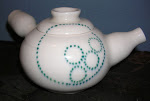
The photos here are two of my favorites--and a good example of the difference between lighter and darker clay, and the front vs the back of the kiln (the darker teapot is Santiam at the front of the kiln, while the more peachy teapot is Deschutes White from farther back).

Jay is planning to fire again in August and I hope to be invited back. I'll probably re-fire a few pieces then. Might put a couple in the MHCC Nanagama this June too and see how they change. Remind me to write more about that--we're going to harvest wood next weekend. I'm so happy to have done the firing at Jay's before that trip--I'll know much more about what we're doing!

Stay tuned, I'll update the gallery soon with some newer pieces, and I'm working on opening at Etsy shop!

Monday, April 6, 2009

Woodfire Weekend!

Ok, so remember back when I was trying to decide whether to go to Arrowmont or to a woodfire in Alsea, and I chose the woodfire? I just got back from the firing weekend. I absolutely made the right choice, it was awesome!

First, and most importantly, the people were really cool. Everyone was super welcoming and by the end of the first day I felt like I'd known them all for...well, for more than a day.

Second, the food was fantastic. I made a quinoa/tabouli salad--used the Moosewood tabouli recipe but subbed quinoa for Bulgar. Came out really good. But the highlights of the weekend were...it's hard to say because all the meals were great...the curry with prawns and sweet potatoes, the chili verde, and the ribs (I don't usually like ribs, but they were really good!). Oh, and the pumpkin-pie-squares with pecans on top. I'm getting hungry just thinking about all the great food!

Third, the location was wonderful. Jay's property is southwest of Corvallis, past Mary's Peak. Hiked up the hill one day and got some wonderful views of the coast range. Plus the weather went from rain on Thursday and Friday to balmy sunny days on the weekend. Not too warm, but cloudless.

Of course it wasn't all fun and games, there was a lot of work too. When I first arrived, I helped Sandy clean out the kiln. It had to be vacuumed out, and all the stuck-on wads chipped off. Throughout the weekend we were constantly hauling and splitting wood too (with a fancy power-splitter!). But everyone chipped in so the work was not too grueling. Spending a few days working hard felt good, since I usually spend my days at a computer.

The hardest part is now--waiting until Friday to unload and see how everything comes out. It takes all week for the kiln to cool enough to unload, and the waiting is torture. But I've seen work from previous firings and I have no doubt that I'll get some lovely pieces out of this one.

See more pictures from the firing here: http://www.flickr.com/photos/76363470@N00/tags/diggermountain/

Tuesday, March 17, 2009

Why Volvox?

On my website, I talk a little about Volvox aureus, and why I named the site after these colonial microorganisms, but this morning in the shower (where I do all my best thinking), I was giving it more thought. Decided I’d dissect the idea a little deeper.

As you may know, I studied Biology as an undergrad. Actually, I've studied biology my whole life – my parents both work in science/natural resources. Though my current career is not related to biology, the upbringing and education certainly shape my mind-set and artistic aesthetic. I like the idea that the name of my work connects my science background and my artistic expression.

The name Volvox comes from the Latin volvere, which means to roll (the ending –ox turns volv- into a personal adjective). There’s the obvious connection to wheel-throwing of course. Also, many of my forms are very round—more than just radial-symmetry from the wheel. My thrown forms tend to be somewhat spherical (teapots and vases are more short and round than tall and narrow). Even my hand-built figures tend to have an overall spherical bent—toes are made from little balls, human forms tend to have round bellies, etc. I’m not sure why that is. I’m just drawn to circles and spheres. They're very aesthetically pleasing, relaxing, satisfying forms.

Of course Volvox were named rollers for a reason. They're spheres within spheres. The parent (or grandparent) colony contains daughter (sometimes granddaughter) colonies. The spheres basically just float around, photosynthesizing and dividing until the daughters get too big for their britches, at which time the parent sphere breaks open to release the daughter colonies into the world. That's sort of how I feel about learning pottery. I started by taking classes, where I was part of a community of baby-potters, not ready to be on our own. After a while, I became a parent of sorts--still within the grand-parent pottery class, but starting to share my experience with others. This year, leaving PCC to join Radius has been a sort of release from the protective sphere of the classroom.

Pottery is a communal activity beyond the classroom. We all produce our own work, but we depend on other potters for a lot. Think this is something I'd like to explore in a separate post.

Tuesday, March 3, 2009

On becoming a (very) small business owner.

VolvoxAureus recently became Volvox Pottery LLC. Yep, I decided to register Volvox as a business.

My reasons for registering Volvox were mostly financial. Now that I'm paying studio rent, I can write off the expense if it's for a business (I haven't heard of anyone being audited, but according to the IRS, I have to show a profit in 2 out of the next 5 years). It also keeps me from getting personally sued if my pottery hurts someone somehow (my boss's idea).


I didn’t realize there would be unintended (positive) consequences of creating a business. My attitude has changed. Now that Volvox is a business, I’m thinking much more about my future as an artist and how I can be viable as an artist and a business. I’ve said before that I want my work to be more coherent, but that’s even more important now that it’s legally more than a hobby. I think more about getting work together for a show, and what it will take to get my work into a gallery, or find a space where I can show it myself. I have cards, and I actually give them to people. I twitter pictures from the studio to show my process to anyone who might be paying attention.

At the same time, I’m trying hard not to put the cart before the horse. I know I can’t afford (and am not really ready for) my own private studio space with all my own equipment. Given that I’m only just starting to bisque my own work, I still have some learning to do before I can go off on my own. But I can't help but think about what it would be like to have my own studio, and of course the gallery I've always wanted. Forming Volvox Pottery LLC is a step in that direction and makes the possibility of having my own art-related business seem a little more possible. Someday.